
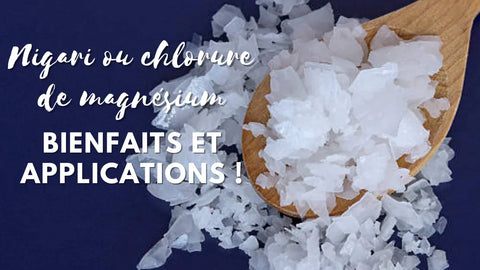
Today, we are going to focus on Nigari salt and explain its benefits, contraindications, and most importantly, how to use it!
What is Nigari, or magnesium chloride?
Magnesium chloride, also known as Nigari (its Japanese name), is a mineral salt extracted from seawater. Unlike its cousin, table salt, which is sodium chloride, it is rich in magnesium and low in sodium.
Nigari has been known for centuries for its health and wellness properties.
A little old-fashioned these days, magnesium chloride salts have fallen out of favor due to their effects on the intestinal barrier in particular. However, it remains an inexpensive way to supplement magnesium and therefore deserves its place on the shelves.
What is Nigari used for?
Nigari is a multi-purpose dietary supplement. It is primarily its magnesium richness that gives it numerous officially recognized benefits for the body, including:
- Reduces fatigue and stress: Magnesium is essential for energy production and nerve function. Nigari can therefore help combat fatigue, anxiety, and sleep disorders.
- Improves intestinal transit: Magnesium has a mild laxative effect that can help relieve occasional constipation. In reality, however, it all depends on the dosage used. Magnesium helps draw water into the intestines and stimulate bowel movements. A deficiency can lead to chronic constipation and hard stools.
- Strengthens your immune system: Magnesium plays an important role in the functioning of the immune system. Nigari can therefore help prevent infections and strengthen natural defenses.
- Relieves muscle and joint pain: Magnesium is a natural muscle relaxant that can help soothe cramps, aches, and joint pain.
- Improves skin and hair health: Magnesium is essential for skin and hair health. Nigari can therefore help hydrate the skin, reduce acne, and strengthen hair.
- Participates in the optimal functioning of the nervous system: Magnesium is necessary for the transmission of nerve signals between nerve cells. A magnesium deficiency can disrupt this communication.
How to use Nigari or magnesium chloride?
Nigari generally comes in the form of powder or salt flakes. Often packaged in small, economical bags, it can be diluted in water and drunk as a beverage, or applied to the skin.
Here are some basic dosages:
For an anti-fatigue Nigari drink:
- Dilute 1/2 teaspoon of Nigari in a liter of water. Careful, it is bitter.
- Start by drinking one glass per day and increase gradually up to 2 glasses per day if necessary.
- Drink the beverage throughout the day, preferably between meals.
You can of course store your preparation in the fridge for a week.

For topical application:
- Dilute 1 teaspoon of Nigari in 100 ml of water.
- Apply the solution to the skin using a cotton ball or compress.
- Let it sit for a few minutes before rinsing.
Recipe for a relaxing Nigari and lavender bath
Ingredients:
1/2 cup of Nigari (magnesium chloride)
10 drops of lavender essential oil
1 tablespoon of vegetable oil (optional)
Instructions:
Fill your bathtub with hot water (about 38°C).
Add the Nigari and the lavender essential oil to the water.
Mix well to dissolve the Nigari.
Add the vegetable oil if you wish. This will help moisturize your skin.
Soak in the bath and relax for 20 to 30 minutes.
 Discover Celnat Nigari
Tips:
You can also add other essential oils to your bath, such as chamomile oil, ylang-ylang oil, or neroli oil.
For an even more relaxing effect, dim the lights in your bathroom and light some candles.
You can also add flower petals or fresh herbs to your bath.
Be sure to rinse your skin well after the bath to remove any Nigari residue.
Beware of the risk of falling asleep due to relaxation ;), jokes aside, this bath is great for deep relaxation.
Contraindications of Nigari or magnesium chloride
Nigari is generally well tolerated by most people. However, it is important to respect the recommended dosages and not to exceed 2 grams per day.
Nigari is not recommended for people suffering from:
- Kidney failure
- Chronic diarrhea or a sensitive gut
- Hypotension (low blood pressure)
- Heart disease
It is also important to consult a doctor before using Nigari if you are pregnant or breastfeeding.
Find out how to perform a gentle cleanse with Nigari!



Comments (3)
Oui, vous pouvez tout à fait fabriquer votre “huile de magnésium” maison avec du nigari (qui est du chlorure de magnésium marin naturel, généralement à environ 84-95 % de chlorure de magnésium).Il ne s’agit pas d’une huile au sens littéral (pas d’huile végétale), mais d’une solution aqueuse concentrée de chlorure de magnésium qui a une texture huileuse quand on l’applique (d’où le nom courant “huile de magnésium” ou “huile sèche”).Voici la recette la plus courante et la plus simple utilisée avec du nigari :Recette classique (concentration forte – type “huile de magnésium” classique)Ingrédients :½ volume de nigari (paillettes ou cristaux)
½ volume d’eau (de préférence eau déminéralisée, distillée ou eau de source faiblement minéralisée pour éviter les réactions)
Exemple concret pour un petit flacon :50 g de nigari
50 ml d’eau (ou 50 g si vous pesez aussi l’eau)
Préparation :Faites chauffer l’eau (pas besoin de la porter à ébullition, tiède suffit ~40-60 °C).
Versez le nigari dans l’eau chaude petit à petit en remuant bien jusqu’à dissolution complète.
Laissez refroidir.
Transvasez dans un flacon spray en verre ambré (idéal) ou en plastique PET.
Conservez à température ambiante ou au frais.
Variante plus douce (si picotements trop forts)Beaucoup de personnes trouvent la version 50/50 trop concentrée au début (picotements / sensation de brûlure sur la peau, surtout si on manque de magnésium).Version 30-33 % (souvent recommandée pour commencer) :1 volume de nigari pour 2 volumes d’eau → ex. 50 g de nigari + 100 ml d’eau
Version encore plus progressive :1 volume nigari pour 3 volumes d’eau → ex. 50 g nigari + 150 ml d’eau
Comment l’utiliser ?Appliquez sur peau propre (idéalement après la douche sur peau encore un peu humide).
Vaporisez ou appliquez au creux de la main et massez (ventre, cuisses, mollets, bras, nuque…).
Laissez pénétrer 20-30 min avant de rincer si vous le souhaitez (mais beaucoup ne rincent pas).
Picotements = normal au début → signe fréquent de carence. Ils diminuent généralement après quelques jours/semaines d’utilisation régulière.
Commencez par de petites quantités et augmentez progressivement.
Points importantsLe nigari contient un peu de sel (chlorure de sodium) et d’autres minéraux → c’est normal, mais ça peut légèrement augmenter les picotements par rapport au chlorure de magnésium pur de pharmacie.
Si vous avez la peau très sensible ou des lésions, testez d’abord sur une petite zone.
En cas de doute (problèmes rénaux, cœur, etc.), demandez conseil à un médecin ou pharmacien avant une utilisation prolongée.
Cette préparation maison est très économique comparée aux sprays du commerce (souvent à base de source Zechstein à 31 %).
Bon courage pour votre préparation, et n’hésitez pas si vous avez d’autres questions !
Cordialement
Bonjour
Je voudrais savoir si je peux faire de l’huile de magnésium avec du nigari et quelle quantité. Merci.
Cordialement
Baysse Jacqueline
Bonjour, j’ai pris régulièrement du nigari à 40g/litre depuis un mois 300ml.jour. au début j’ai eu plutôt des selles ramollie e or voici qu’à 2 reprises j’ai eu des constipation sévères-quasi impossibilité à exonérer des selles ultra compactes. J’ai 80ans et voulais faire cette cure comme fortifiant. Je pense avoir eu un effet pervers paradoxal de cette cure. Qu’en pensez vous ?
Bien cordialement.