
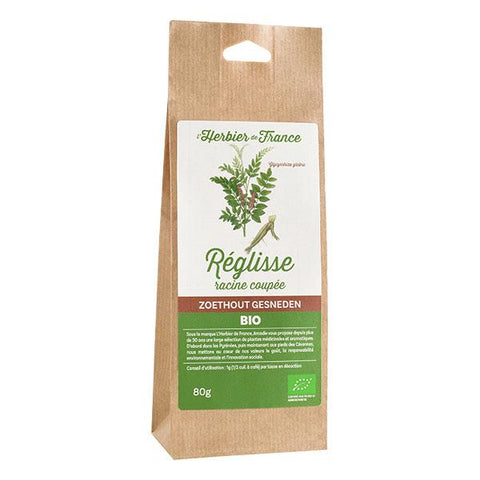
Organic licorice root sticks, 50 g
Remaining stock : 10
 24/48h shipping
 Home delivery or delivery to relay points from €4.30, free from €60
 100% compensated Green delivery
Organic liquorice root sticks, 50 g
Discover the organic liquorice root sticks from the brand Herbiers de France: root sticks, 50 g. Certified organic farming, in a kraft paper bag.
Liquorice (Glycyrrhiza glabra) is a plant whose root, used since antiquity, offers a sweet, aniseed, and deep flavor. In stick form, it can be chewed, prepared as a decoction, or added to herbal teas to mellow their taste.
Botanical overview
Glycyrrhiza glabra is a perennial plant in the Fabaceae family that can reach 1.5 meters in height. It develops long rhizomes and deep roots, yellow on the inside, which are harvested after several years of cultivation. Its leaves are composed of oval leaflets, and its pale blue to violet flowers are grouped in clusters.
The root contains glycyrrhizin, a triterpenoid compound with a sweetening power about 50 times greater than that of sucrose, as well as flavonoids (liquiritin, isoliquiritigenin) and polysaccharides.
Aromatic and taste profile
Liquorice offers a sweet, aniseed, and slightly woody flavor, with a characteristic long finish. When prepared as a decoction, it produces an amber liqueur with a rounded taste. It is often used to sweeten more bitter herbal teas.
How to prepare the decoction
- Quantity: 1 to 2 sticks broken into small pieces (5 to 10 g) for 500 ml of cold water, prepared as a decoction
- Cooking: bring to a boil, then simmer over low heat
- Duration: 10 to 15 minutes of simmering, then filter
- Frequency: maximum 2 cups per day. You can also add other plants when turning off the heat and let steep for an additional 5 minutes
Composition
| Ingredient | Detail |
|---|---|
| Liquorice (Glycyrrhiza glabra) | Root sticks |
| Certification | Certified organic farming |
| Packaging | Kraft paper bag, 50 g |
| Origin | France |
Precautions for use
- Not recommended in case of high blood pressure: glycyrrhizin can increase blood pressure with prolonged daily consumption
- Do not exceed 4 weeks of continuous consumption without medical advice
- Not recommended for people suffering from kidney disease or heart failure
- Not recommended for pregnant or breastfeeding women
- Not recommended if taking diuretic, corticosteroid, or antihypertensive treatments without medical advice
- Not recommended for people with a history of hormone-dependent conditions
- Do not exceed recommended usage amounts
- Food supplements are not a substitute for a varied and balanced diet
- Keep out of reach of children
FAQ
Is the Herbiers de France liquorice root certified organic?
Yes, this liquorice root is certified organic, free from pesticides or synthetic chemical inputs.
How long can liquorice be consumed each day?
As a precaution, it is recommended not to exceed 4 weeks of continuous daily consumption without medical advice, due to the glycyrrhizin content.
Is liquorice suitable for children?
Its flavor appeals to children, but the glycyrrhizin content requires caution. Seek the advice of your doctor or pharmacist.
How do you use a liquorice stick?
You can chew it, boil it in a decoction, or drop a piece into an herbal tea to sweeten it. For a decoction, break the stick into pieces to release its aromas.
We clean up after ourselves.
Ecommerce deliveries have a carbon footprint. That's why we support verified projects that remove carbon from the air.


Every delivery’s carbon footprint is calculated based on weight, shipping method, and distance traveled. We neutralize these emissions by purchasing verified carbon removal credits from groundbreaking projects.


With your purchase, you’ll join a community of proactive merchants and customers dedicated to a sustainable future. Together, we've removed emissions for over 88 million deliveries and removed over 60 thousand tonnes of carbon.
We work with a network of pioneering carbon removal companies that have been vetted by the commerce platform Shopify.

