
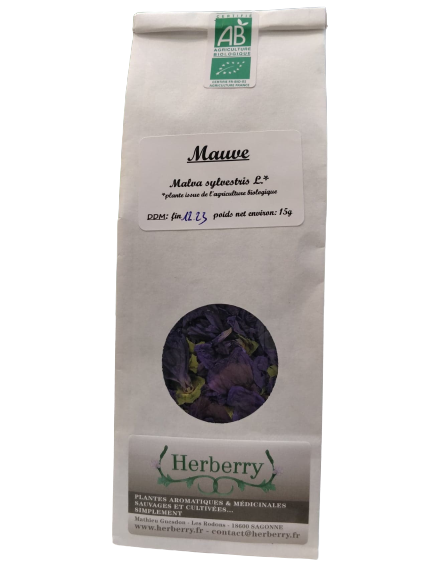
Mallow for herbal teas-15g-Herberry
Remaining stock : 10


 24/48h shipping
 Home delivery or delivery to relay points from €4.30, free from €60
 100% compensated Green delivery
Organic mallow flowers for herbal tea — An emollient plant from European herbalist tradition
Common mallow (Malva sylvestris) is a biennial or perennial plant of the Malvaceae family, widely distributed throughout Europe. Its large, purple-pink, purple-veined flowers make it one of the most beautiful medicinal plants found along roadsides and in gardens. In traditional herbalism, its flowers and leaves are used to prepare gentle, slightly mucilaginous infusions. Herberry offers dried mallow flowers, certified organic.
Botanical overview
Malva sylvestris is a robust plant that can reach 30 to 120 cm depending on the conditions. Its rounded, lobed, slightly hairy leaves and flowers with 5 pink-violet petals featuring characteristic dark veins make it easily identifiable. Flowering occurs from May to September. It grows spontaneously in wasteland, along roadsides, and in gardens throughout Europe.
The flowers and leaves contain mucilage (polysaccharides, notably galacturonans), flavonoids (gossypetin, malvin), anthocyanins (responsible for the violet color), and tannins. A high mucilage content is the main phytochemical characteristic of mallow.
Aromatic and taste profile
Mallow flower infusion presents one of the most spectacular colors in herbalism: an intense blue-violet that can turn pink depending on the water's pH (more acidic = pink, more alkaline = blue-green). Its taste is very mild, slightly sweet, and mucilaginous—you can feel a slightly slippery texture, characteristic of mucilage. Practically without bitterness, it is one of the gentlest herbal teas available.
How to prepare the infusion
- Quantity: 1 to 2 teaspoons of dried flowers (about 1.5 to 2 g) per cup
- Water: lukewarm to simmering, about 80-90°C (cold maceration for 30 minutes in room-temperature water better preserves the mucilage)
- Infusion: 8 to 10 minutes covered, or cold macerate for 20-30 minutes
- Strain and enjoy warm or at room temperature
- Frequency: 2 to 3 cups per day
Composition
| Ingredient | Detail |
|---|---|
| Common mallow (Malva sylvestris) | Dried flowers |
| Certification | Certified organic farming |
| Packaging | Resealable 15 g kraft bag |
| Origin | Europe |
Precautions for use
- Not recommended for pregnant or breastfeeding women without medical advice
- Not recommended for children under 6 years old
- Mucilage can interfere with the absorption of certain medications — allow a 2-hour interval between the herbal tea and medication intake
- Do not exceed recommended quantities
- Dietary supplements are not a substitute for a varied and balanced diet
FAQ
Is Herberry's organic mallow certified?
Yes, these mallow flowers are certified organic, free from pesticides or synthetic chemical inputs.
Why does mallow infusion change color?
The anthocyanins present in mallow flowers are pigments highly sensitive to pH. In slightly acidic water (hard, calcareous), the infusion turns pink-red; in softer or slightly alkaline water, it remains blue-violet. This color change is natural and does not mean the tea is of lower quality. In fact, it can be used as a "natural pH paper" — a few drops of lemon juice will make it turn pink immediately.
What is the difference between common mallow and other mallow species?
Common mallow (Malva sylvestris) and other related mallows (sometimes referred to as Malva neglecta or other species) all belong to the Malva genus. Common mallow is the species most widely used in European herbalism, particularly for its high mucilage content and large flowers.
How should I store my bag of mallow?
Keep away from direct light (anthocyanins degrade in light), heat, and humidity. Consume preferably within 12 months of opening.
Discover other Herberry herbal teas: See the full Herberry range
We clean up after ourselves.
Ecommerce deliveries have a carbon footprint. That's why we support verified projects that remove carbon from the air.


Every delivery’s carbon footprint is calculated based on weight, shipping method, and distance traveled. We neutralize these emissions by purchasing verified carbon removal credits from groundbreaking projects.


With your purchase, you’ll join a community of proactive merchants and customers dedicated to a sustainable future. Together, we've removed emissions for over 86 million deliveries and removed over 60 thousand tonnes of carbon.
We work with a network of pioneering carbon removal companies that have been vetted by the commerce platform Shopify.

