
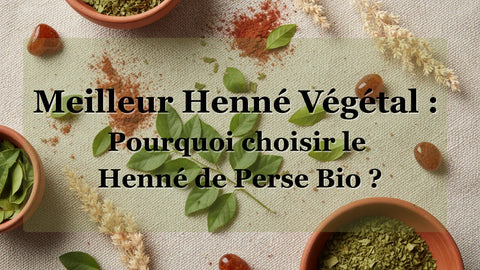
Organic Persian Henna: The best choice for natural hair coloring
By Marie, dietitian and advisor specializing in natural solutions at Pleine Forme
16 years of experience in natural health and organic cosmetics
Are you tired of chemical dyes that damage your hair? Your scalp is irritated, and your lengths are dry and brittle. You are looking for a natural alternative, but faced with the multitude of hennas on the market, you are lost. Which one to choose? What quality? What shades?
What if the solution lay in an age-old henna, grown on the arid lands of Iran, recognized as the best henna in the world? Organic Persian henna: a plant-based dye that colors, treats, and protects simultaneously.
In my 16 years at Pleine Forme, I have helped hundreds of people disappointed by conventional dyes transform their hair with Persian henna. Strengthened hair, radiant shine, vibrant color, soothed scalp. Without a single chemical.
In this guide, I reveal why Persian henna, especially that of Nomade Palize, is the ultimate choice for an authentic natural color: origins, benefits, shades, and application protocol.
🔍 Is your current hair dye damaging your hair? Self-assessment
Check the symptoms present:
Condition of your hair:
- ☐ Dry hair, rough to the touch
- ☐ Systematic split ends
- ☐ Significant breakage (hair that breaks when brushing)
- ☐ Loss of shine, dull appearance
- ☐ Fine hair, lacking volume
Scalp issues:
- ☐ Itching after coloring
- ☐ Irritation, redness
- ☐ Dandruff or seborrhea
- ☐ Burning sensation during application
Disappointing coloring results:
- ☐ Color that fades quickly (undesirable highlights)
- ☐ Poor gray hair coverage
- ☐ Visible demarcation line as roots grow out
- ☐ Artificial, unnatural color
✅ If you checked 5 signs or more, your hair is suffering. Persian henna is the solution.
Why Persian henna is the best plant-based henna in the world.

Iran: the historical cradle of superior quality henna
Iran is not just another henna producer. It is THE ancestral land of Lawsonia inermis of exceptional quality. For more than 5,000 years, this region has cultivated and perfected the production of henna.
What makes Iranian henna unique:
1. Exceptional arid terroir: The desert regions of Iran (Kerman, Yazd, Isfahan) impose extreme conditions on the plant. To survive, the Lawsonia inermis concentrates its active ingredients:
- Lawsone (pigment): 3-4% (vs 1-2% elsewhere)
- Essential oils: Maximum concentration
- Tannins: Enhanced astringent properties
Result: A more powerful henna, deeper color, amplified treatment action.
2. Optimal climatic conditions
- Intense sunshine (300 days/year)
- Significant day/night temperature fluctuations
- Poor soil, forcing the plant to draw nutrients from deep down
- = Robust plant, rich in active ingredients
3. Millennial know-how: Iranian producers have mastered:
- Harvesting at the optimal time (maximum lawsone concentration)
- Traditional drying (preserves active ingredients)
- Ultrafine grinding (micronized powder = better uptake)
Persian henna vs other origins: comparison
| Criteria | Persian Henna (Iran) | Indian/Pakistani Henna | Maghreb Henna | Egyptian Henna |
|---|---|---|---|---|
| Lawsone (pigment) | 3-4% ⭐⭐⭐ | 1.5-2% | 1-1.5% | 2-2.5% |
| Purity | 100% pure ⭐⭐⭐ | Often mixed | Variable | Average |
| Obtained color | Deep, vibrant ⭐⭐⭐ | Dull | Faded | Decent |
| Application time | 45-90 min | 2-3h | 2-4h | 1.5-2h |
| Treatment properties | Maximum ⭐⭐⭐ | Average | Weak | Average |
| Price | €€€ | € | € | €€ |
💡 Verdict: Persian henna costs more, but offers an unmatched quality/result ratio.
Nomade Palize: the reference for organic Persian henna
At Pleine Forme, we have selected Nomade Palize for its guarantees:
✅ Direct sourcing from Iran: Ancestral lands (Kerman)
✅ Organic AB certification: 100% pure, no additives
✅ Rigorous quality control: Lawsone rate verified
✅ Ethics: Fair trade, support for local producers
✅ Vegan: No animal testing, no animal ingredients
✅ Guaranteed freshness: Vacuum-packed, optimal shelf life
The 7 proven benefits of Persian henna for your hair

Henna is more than just a hair color. It is a complete hair treatment recognized since antiquity.
1. Strengthening of the hair fiber ⭐⭐⭐
Mechanism: Unlike oxidation dyes that open the cuticles (weakening them), henna deposits on the surface and coats the hair.
Results:
- Reduced breakage: -60 to 80%
- Thicker hair (diameter increases by 10-15%)
- Increased mechanical resistance (less hair in the brush)
Ideal for: Fine, fragile, brittle hair
2. Coating and smoothing of the cuticle ⭐⭐⭐
Action: Henna coats every strand in a protective layer, smoothing the cuticles.
Results:
- Hair feels smoother to the touch
- Spectacular shine (luminous highlights)
- Protection against external aggressions (pollution, UV, heat)
Typical testimonial: "After 3 hennas, my hair shines like never before. People ask me what miracle product I use!" – Claire, 38 years old
3. Volume and hair density ⭐⭐
Mechanism: By thickening each hair individually, henna creates a fuller hair mass.
Results:
- +20 to 30% visual volume
- Impression of "thicker" hair
- Style holds better
Ideal for: Flat, limp, fine hair
4. Sebum regulation and scalp purification ⭐⭐⭐
Action: Henna's tannins have an astringent and cleansing effect.
Results:
- Oily hair: less frequent washing required (+2-3 days)
- Reduced dandruff (mild antifungal action)
- Soothed scalp (anti-inflammatory)
Ideal for: Oily roots, dandruff, irritated scalp
5. Natural coverage of gray hair ⭐⭐⭐
Efficacy: Persian henna covers 90-100% of gray hair from the first application (copper/red shades). For chestnut/black tones, 2 applications may be necessary.
Advantage vs chemical coloring:
- No brutal demarcation line as roots grow out
- Gradual coloring that harmonizes naturally
- No visible "white" roots (blended gradient)
6. Thermal and UV protection ⭐⭐
Action: The henna coating creates a physical barrier protecting the hair.
Results:
- Protection against blow dryers, straighteners, curling irons (up to 180°C)
- Anti-UV shield (prevents sun bleaching)
- Hydration retention (less dry hair)
7. Zero harmful effects, 100% natural ⭐⭐⭐
Unlike chemical coloring:
❌ No ammonia (irritating, toxic)
❌ No peroxide (oxidizing, dries out)
❌ No paraphenylenediamine (PPD) - major allergen
❌ No resorcinol (endocrine disruptor)
❌ No metallic salts (incompatible with bleaching)
✅ Organic Persian henna is the healthy and safe alternative
The shades of Persian henna: find yours

Nomade Palize offers 4 shades to meet all needs.
1. Copper Henna - Warm and flamboyant highlights ⭐⭐⭐
Composition: 100% Lawsonia inermis (pure henna)
Obtained color:
- On light/blonde hair: Intense copper red
- On light chestnut: Luminous auburn
- On dark chestnut: Mahogany highlights
- On white hair: Copper orange (1st application), copper red (2nd application)
Application time:
- Light highlights: 30-45 min
- Intense color: 1h-1h30
For whom?
✅ Craving warmth, luminosity
✅ Natural auburn highlights
✅ Solar, assertive personality
2. Chestnut Henna - Natural elegance ⭐⭐⭐
Composition: Lawsonia inermis + Indigofera tinctoria (indigo)
Obtained color:
- On light hair: Golden chestnut
- On natural chestnut: Intensification + warm highlights
- On dark hair: Chocolate highlights
- On white hair: Medium chestnut (2 applications necessary)
Application time: 1h-1h30 minimum
For whom?
✅ Discreet, natural color
✅ Sober gray hair coverage
✅ Neutral, professional tone
3. Black Henna - Intense depth ⭐⭐
Composition: Lawsonia inermis + Indigofera tinctoria (high concentration)
Obtained color:
- On dark chestnut hair: Very dark brown, almost black
- On black hair: Intensification + bluish highlights
- On white hair: Dark brown (2-3 applications necessary for deep black)
Application time: 1h30-2h
For whom?
✅ Naturally dark hair
✅ Seeking depth
✅ Dark tone gray hair coverage
⚠️ Warning: Black henna contains indigo, which may bleed slightly during the first few weeks (pillowcase).
4. Neutral Henna - Treatment without coloring ⭐⭐⭐
Composition: Cassia obovata (neutral henna) - 0% lawsone = 0% pigment
Action:
✅ All the benefits of henna (coating, shine, volume)
❌ No color change
Application time: 30-60 min (hair mask)
For whom?
✅ Already chemically colored hair that needs treatment
✅ Blondes who do not want any highlights
✅ Deep treatment without color commitment
✅ Problematic scalp (dandruff, irritation)
Frequency: 1-2×/month as a cure
Application protocol: succeed in your Persian henna plant-based coloring

Required equipment
- Nomade Palize henna powder (quantity depends on length)
- Glass or ceramic bowl (no metal = oxidation)
- Wooden or plastic spoon
- Hot water (70-80°C, not boiling)
- Applicator brush or gloves
- Cling film or shower cap
- Old towel (henna stains)
- Cape or old t-shirt
Powder quantity based on length
- Short hair: 50-100g
- Mid-length: 100-150g
- Long: 150-250g
- Very long/thick: 250-350g
Step 1: Hair preparation (Day -1)
Clarifying shampoo mandatory: Wash your hair with a silicone-free shampoo (e.g., neutral organic shampoo). Silicones create an impermeable barrier preventing the henna from penetrating.
Drying: Clean and dry hair (or slightly damp to facilitate application)
⚠️ Do not apply conditioner/mask: this would block the henna uptakeStep 2: Paste preparation (30 min before application)
Method:
- Pour the powder into the bowl
- Gradually add hot water (70-80°C)
- Mix until the consistency of stirred yogurt (neither too liquid nor too thick)
- Let sit for 15-30 min (lawsone release)
Ideal texture: The paste should flow slightly from the spoon but remain creamy.
Color boost tip:
- Add 1 tbsp of lemon juice (acid = lawsone release)
- Or 1 tsp of apple cider vinegar
Step 3: Application (care and method)
Professional technique:
- Protect your skin: Apply vegetable oil on forehead, temples, neck (prevents stains)
- Divide hair into 4 sections: 2 in front, 2 in back (clips)
- Start at the nape: Take thin strands (2-3 cm)
- Apply generously: From root to tip, complete saturation
- Massage lightly: To ensure penetration
- Work up gradually: Section by section
- Roots last: If you already have henna (avoids over-intensification)
For gray hair: Insist on the white areas (double layer if necessary)
Step 4: Application time (crucial)
Wrap the hair:
- Twist hair into a bun
- Cover with cling film (heat = better uptake)
- Wrap with a warm towel (optional: heating cap)
Duration based on objective:
| Objective | Application time |
|---|---|
| Light highlights | 30-45 min |
| Medium color | 1h-1h30 |
| Intense color | 1h30-2h |
| Gray hair | 1h30-2h minimum |
| Neutral henna treatment | 30-60 min |
Activity during application: Reading, watching a show, chores... Stay warm (avoid cold = slows oxidation)
Step 5: Rinsing (patience)
Method:
- Rinse thoroughly with lukewarm water (not hot = does not set as well)
- Until the water runs clear (10-15 min of rinsing required)
- No shampoo immediately (risk of stopping oxidation)
- Condition lightly if hair is dry (avoids "cardboard" effect)
Drying: Let dry naturally if possible
Step 6: Oxidation (48-72h)
Patience = key to the final color
- First hours: Orange color (normal, that is the raw lawsone)
- 24h: Color begins to darken
- 48h: Final color revealed (copper/auburn)
- 72h: Complete stabilization
⚠️ Do NOT judge the color the same day: It will evolve significantly
First shampoo: 48-72h after application (gentle shampoo)
Care and frequency
Reapplication:
- Roots: Every 4-6 weeks (regrowth)
- Lengths: Every 2-3 months (color maintenance + conditioning)
Between 2 hennas:
- Sulfate-free gentle shampoos
- Nourishing masks (coconut, argan, avocado oil)
- Protect from pool chlorine (causes slight fading)
Organic henna vs. conventional henna: why certification matters

The dangers of low-end henna
Common toxic additives:
❌ Metallic salts (sodium picramate): Explosive reaction with bleaching/perms
❌ PPD (paraphenylenediamine): Major allergen, banned in Europe above 2%
❌ Synthetic dyes: Distort color, cause irritation
❌ Filler plants: Dilute purity, mediocre results
Consequences:
- Severe allergies (eczema, edema)
- Burnt, brittle hair
- Inability to return to conventional dyes (chemical reaction)
Nomade Palize organic certification: guarantees
✅ 100% pure: No additives, metallic salts, or dyes
✅ Controlled: Lawsone analysis, absence of contaminants
✅ Traceability: Certified Iranian origin
✅ Ethical: Fair trade
✅ Vegan: Exclusive plant-based formula
💡 Invest in quality: Organic henna costs €9-20 per sachet but lasts 3-6 months (vs. salon coloring €60-120 every month).
FAQ: Your questions about Persian henna
Does henna damage hair?
No, on the contrary. Organic Persian henna is a treatment. It coats, protects, and strengthens. Unlike chemical dyes that open the hair cuticles, henna smoothes them.
Can henna be applied to previously chemically dyed hair?
Yes, but:
- Wait 2-3 months after the last chemical dye
- Perform a strand test (verify reaction)
- Start with neutral henna (treatment) then color
⚠️ Never the reverse: Chemical dye over henna = unpredictable result
Does henna wash out completely?
No, henna is permanent. It fades very gradually (6-12 months) but never disappears completely. This is why the strand test is crucial.
How long does the color last?
The color lasts 3-6 months before needing a complete refresh. Roots are touched up every 4-6 weeks.
Can you lighten hair with henna?
No. Henna can only darken or add highlights. It does not bleach. To lighten, only chemical bleaching works (not recommended after henna).
Is henna suitable for pregnant/breastfeeding women?
Yes, pure organic henna is safe during pregnancy/breastfeeding. It is actually the ideal alternative to chemical dyes (toxic to the fetus).
How to remove henna stains on the skin?
Solutions:
- Vegetable oil + gentle scrub
- Lemon juice (gradually lightens)
- Patience (naturally fades in 7-10 days)
Prevention: Apply oil to forehead/temples before application
Conclusion: Persian henna, your natural beauty ally
After 16 years at Pleine Forme, I can state: Nomade Palize organic Persian henna is the best natural hair investment.
The 5 reasons to choose Persian henna
1. Unmatched quality: Maximum lawsone content, ancestral origins
2. Coloring + treatment: 2-in-1, transformed hair
3. Total safety: 100% natural, organic, vegan
4. Lasting results: Vibrant color for 3-6 months
5. Economical: €15-25 for 3-6 months vs. €60-120/month at a salon
My message to you
Your hair deserves better than toxic products. Persian henna is not a passing trend; it is a millenary tradition validated by modern science.
In 2-3 applications, you will notice:
✅ Strengthened hair, less breakage
✅ Spectacular shine
✅ Natural volume
✅ Soothed scalp
✅ Vibrant, natural color
At Pleine Forme, we help hundreds of people every year abandon chemical dyes for henna. Hair transformation guaranteed.
Need personalized advice? Our team is available for:
- Choosing the right shade
- Customized protocol
- Regular follow-up
Together, let's reveal the natural beauty of your hair!
Where to buy Nomade Palize organic Persian henna?
At Pleine Forme, we offer:
- Copper Henna: Warm highlights---See the product
- Chestnut Henna: Natural elegance---See the product
- Black Henna: Intense depth---See the product
- Neutral Henna: Non-coloring treatment---See the product
Guarantees:
- Organic AB certification
- Traceable Iranian origin
- Optimal freshness
- Free advice
Available: In-store (demonstration possible) or online (24-48h delivery)
Click the image to browse the department

Article written by Marie, consultant specialized in organic cosmetics
Last update: August 2026
⚠️ Warning
Always perform an allergy test 48h beforehand (inside of the elbow) and a strand test. Henna is permanent. When in doubt, consult a hairdresser specializing in vegetable dyes.

Comments (0)
There are no comments for this article. Be the first one to leave a message!