
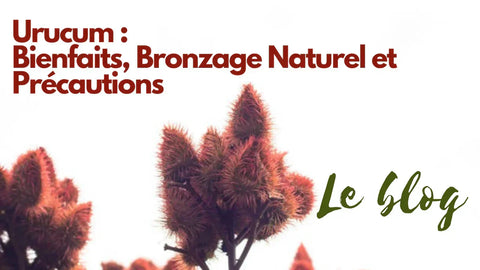
Urucum: The secret to a natural and lasting tan
Looking for a natural tan and glowing skin without compromising your health?
Discover Urucum, the secret of the Amazonian peoples!
Urucum (Bixa orellana), also known as annatto or the lipstick tree, is a tropical shrub native to South America that is revolutionizing natural sun preparation. Its exceptional richness in beta-carotene (the natural pigments responsible for its orange color) makes it the ideal ally for preparing your skin for the sun. This ancestral plant, used for millennia by indigenous Amazonian populations for their rituals and skin protection, deserves special attention.

A short practical glossary to understand Urucum:
- Carotenoids: Natural orange/red pigments that give carrots, tomatoes, etc. their color.
- Melanin: Dark pigment produced by the skin to protect it from the sun (responsible for tanning).
- Beta-carotene: A precursor to vitamin A, a powerful antioxidant.
1. Urucum: a plant with mysterious origins
Urucum grows naturally in the tropical regions of Brazil, Nicaragua, and Bolivia. Its bright red fruit contains seeds covered in a colored pulp rich in natural pigments. Amerindian populations traditionally used it as body paint during sacred rituals, but also for its therapeutic properties.
This remarkable plant has spanned the centuries to become one of the most sought-after food supplements for sun preparation today. Its scientific name, "Bixa orellana," pays homage to Francisco de Orellana, the Spanish explorer who discovered the Amazon in the 16th century.
Did you know? Urucum is responsible for the characteristic orange color of many cheeses such as Mimolette, Cheddar, Edam, and Boulette d'Avesnes. Referenced under the code E160b on food labels, this natural coloring agent transforms initially white curds into cheeses with such a recognizable hue.
2. The exceptional nutritional composition of Urucum
Urucum stands out for its exceptional richness in carotenoids, particularly beta-carotene, bixin, and norbixin. These natural pigments are responsible for its characteristic color and its beneficial properties for the skin.
The beta-carotene concentration in Urucum far exceeds that of a carrot, making this plant one of the most significant natural sources of this vitamin A precursor. This unique composition explains why Urucum is considered a superfood with remarkable antioxidant properties.

3. Urucum and tanning: How does it work?
3.1 Natural tanning activation
Extremely rich in beta-carotenoids, Urucum proves to be the best ally for anyone looking for a glowing and natural complexion. Concretely, the beta-carotene contained in Urucum stimulates the production of melanin, the natural pigment responsible for skin coloration.
In practice: Imagine your skin as a printer. Urucum provides the ink (melanin) necessary to "print" an even tan when you expose yourself to the sun. This activation allows for a faster and more homogeneous tan.
3.2 Prolonging your tan
One of the most appreciated benefits of Urucum is its ability to prolong an acquired tan. Carotenoids accumulate in skin tissues and maintain a golden hue even after sun exposure ends.
This property helps maintain a tanned complexion longer, thereby reducing the frequency of sun exposure needed to maintain a satisfactory tan.

4. Powerful antioxidant properties
Urucum possesses remarkable antioxidant properties thanks to its richness in carotenoids. These compounds neutralize free radicals responsible for premature skin aging and cellular damage.
This antioxidant action helps protect the skin from external aggressions and maintain its elasticity. The anti-aging effects of Urucum make it a valuable ally for preserving skin youthfulness.
5. Little-known cardiovascular benefits
Little known to the general public, Urucum presents interesting cardiovascular benefits. The carotenoids it contains contribute to the protection of blood vessels and the reduction of oxidative stress in the heart.
Preliminary studies suggest that regular consumption of Urucum could contribute to cholesterol regulation and improved blood circulation. These properties deserve further exploration.
6. Effects on vision and eye health
The beta-carotene in Urucum, a precursor to vitamin A, plays an essential role in maintaining optimal vision. This vitamin is indispensable for retinal function and color perception.
Supplementation with Urucum can help prevent certain age-related eye disorders, particularly macular degeneration. However, this therapeutic use of Urucum remains to be further investigated through clinical studies.
7. What are the side effects of Urucum?
7.1 Carotenodermia: skin coloration
Excessive intake of beta-carotene can cause carotenodermia, which manifests as a yellowish or orangey discoloration of the skin. This condition, although generally benign, can be unsightly and worrying for users.
Carotenodermia generally appears after several weeks of overdose and resolves spontaneously when supplementation is stopped. It is therefore crucial to respect the recommended dosages.
7.2 Possible allergic reactions
Urucum can cause an allergic reaction, and medical help should be sought immediately in case of allergic symptoms such as breathing difficulties, nausea, vomiting, or convulsions. These reactions, although rare, require special vigilance.
People sensitive to natural dyes or with a history of food allergies should exercise caution when using Urucum for the first time.
7.3 Drug interactions
Urucum may interact with certain medications, particularly anticoagulants and photosensitizing treatments. It is essential to consult a healthcare professional before starting supplementation.
Interactions with diabetes medications should also be monitored, as Urucum can influence blood sugar levels. Medical supervision is recommended for diabetic patients.
8. Why is Urucum not recommended for smokers?
8.1 Risk of lung cancer
Products containing beta-carotene are not recommended for smokers. Smokers and former smokers should refrain from use, at the risk of developing cancer. This absolute contraindication is based on solid scientific studies.
The ATBC study, aimed at studying the ability of beta-carotene to prevent lung cancer in smokers, showed the opposite effect: the risk of lung cancer was five times higher in smokers receiving 20 mg of beta-carotene each day. A study conducted by Druesne-Pecollo et al. in 2010 also concluded a statistically significant increase in the risk of lung cancer in individuals using beta-carotene as a food supplement at doses equal to or greater than 20 mg per day. If you follow the indicated dosages, Urucum will not cause any problems.
Beta-carotene, in the presence of toxic tobacco compounds, can turn into pro-oxidant substances that promote the development of lung tumors. This paradox makes the antioxidant a dangerous element for smokers.
8.2 Simplified mechanism of action
In smokers, the lung environment is saturated with toxic substances and free radicals (unstable molecules that damage cells). In this hostile context, beta-carotene undergoes a chemical transformation and becomes a free radical itself instead of fighting them.
Simple analogy: It's like a firefighter who, instead of putting out the fire, inadvertently fuels it. This transformation explains why clinical studies have shown a dramatic increase in the risk of lung cancer in smokers supplemented with beta-carotene.
9. Specific contraindications
9.1 Pregnancy and breastfeeding
The use of Urucum during pregnancy is a subject of debate. In the absence of specific studies on safety during this period, it is preferable to avoid supplementation as a precaution.
Breastfeeding is also a period of caution, as carotenoids can pass into breast milk and affect the infant. Medical consultation is essential.
9.2 Liver pathologies
People suffering from liver pathologies must exercise caution with Urucum. As the liver is the organ responsible for metabolizing carotenoids, impaired liver function can lead to excessive accumulation.
This accumulation can aggravate certain liver pathologies and requires appropriate medical monitoring.
10. When to take Urucum?

10.1 Optimal timing for sun preparation
Taking Urucum should ideally begin 4 to 6 weeks before significant sun exposure. This period allows carotenoids to accumulate in skin tissues and optimize their protective effects.
Regularity of intake is essential to maintain sufficient tissue levels. Irregular supplementation compromises the effectiveness of the treatment.
10.2 Example of a daily routine
Optimal routine: Take 1 to 2 Urucum capsules in the morning with a breakfast containing fats (avocado, olive oil, Greek yogurt). Because carotenoids are fat-soluble, they are better absorbed in the presence of lipids.
Typical schedule: March (start of the course) → August (end of the course) with a break in September-October, then possible resumption in March of the following year. This cyclicity respects the natural rhythms of sun exposure.
11. Dosage and methods of administration
11.1 Recommended dosages
The standard dosage of Urucum generally varies between 2 and 6 mg per day, depending on the product's concentration and the desired goal. Beginners should start with the minimum dose to assess their tolerance.
Gradually increasing the dose allows you to optimize the benefits while minimizing the risk of side effects. Patience is necessary because the effects are only visible after several weeks.
11.2 Available dosage forms
Urucum comes in various forms: capsules, powder, liquid extracts, or tablets. Each form has specific advantages in terms of bioavailability and ease of use.
Capsules offer precise dosing and optimal storage, while powder allows for easy integration into the daily diet.
12. Quality criteria and product selection
12.1 Origin and traceability
The quality of Urucum depends largely on its geographical origin and cultivation conditions. Organic products guarantee the absence of pesticides and contaminants.
Full traceability, from cultivation to commercialization, is a guarantee of quality and safety for the consumer.
12.2 Extraction methods
Extraction methods directly influence the concentration of active ingredients and the stability of the final product. Gentle extractions better preserve heat-sensitive carotenoids.
Supercritical CO2 extraction represents the most respectful method, allowing for high-quality extracts to be obtained without residual solvents.
14. Selection of recommended products
14.1 Urucum Vit'all+
Urucum from Vit'all+ stands out for its pharmaceutical-grade formulation and optimized beta-carotene concentration. This French laboratory, recognized for its expertise in natural food supplements, offers a standardized Organic Urucum extract that guarantees a constant content of active ingredients.
The capsule presentation facilitates precise dosing and ensures optimal storage of carotenoids sensitive to light and oxidation. This product is particularly suitable for people seeking a rigorous approach to supplementation.

Click on the image to discover the product
14.2 Urucum in Guayapi tablets
Guayapi Urucum tablets represent a more traditional and authentic approach. This laboratory, which specializes in Amazonian plants, works directly with local producers, guaranteeing exemplary traceability and respect for ancestral knowledge.
The tablet form allows for a gradual release of the active ingredients and is suitable for those who prefer traditional dosage forms. Guayapi's ethical commitment makes it a responsible choice for consumers concerned about social and environmental impact.

Click on the image to discover the product
15. Frequently asked questions (FAQ)
Can Urucum replace sunscreen?
No, absolutely not. Urucum prepares and optimizes the skin's natural defenses, but offers no measurable UV protection. It must always be combined with appropriate external sun protection (cream, clothing, shade).
Can Urucum be combined with other tanning supplements?
Combining it with tyrosine, omega-3s, or vitamin E can be beneficial, but requires medical advice. Absolutely avoid combining multiple sources of beta-carotene, which could create an overdose.
Is Urucum effective on all skin phototypes?
Effectiveness varies depending on the phototype. Light skin (phototypes I-II) benefits less from Urucum than matte to dark skin (phototypes III-VI). Redheads or those with very pale skin should remain particularly cautious.
How long after stopping does the effect disappear?
The acquired coloration fades gradually over 4 to 8 weeks after stopping, depending on individual metabolism and residual sun exposure. Carotenoids stored in the tissues renew slowly.
Is organic Urucum really necessary?
The organic label guarantees the absence of pesticides and superior quality, which is particularly important for prolonged consumption. Pesticide residues can accumulate in the body during several months of supplementation.
Can Urucum be grown in France?
Urucum requires a humid tropical climate and cannot survive French winters. There have been a few attempts in heated greenhouses, but commercial production remains impossible in our latitudes.
17. Myths and realities about Urucum
❌ MYTH: "Urucum provides complete protection from the sun"
REALITY: Urucum prepares the skin and optimizes tanning, but it NEVER replaces sunscreen. It offers no measurable sun protection factor.
❌ MYTH: "Urucum is suitable for everyone"
REALITY: Formally contraindicated for smokers, not recommended for pregnant women or people on anticoagulants.
❌ MYTH: "The more you take, the more you tan"
REALITY: Overdosing causes unsightly orange skin discoloration (carotenodermia) without improving the tan.
✅ REALITY: Urucum really does color our food
Mimolette, cheddar, boulette d'Avesnes... many cheeses owe their orange color to it!
18. Comparative table of galenic forms
|
Form |
Advantages |
Disadvantages |
Target audience |
|
Capsules |
Precise dosage, optimal preservation |
Higher price |
Beginners, occasional use |
|
Powder |
Economical, easy to incorporate into food |
Approximate dosage, oxidation |
Regular users |
|
Tablets |
Gradual release, traditional |
Less convenient to carry |
Purists, long-term use |
19. Expert advice
As an expert in phytotherapy, we recommend a cautious and personalized approach to using Urucum. This remarkable plant deserves respect and attention in its use.
Prior consultation with a professional is essential, especially for individuals with risk factors or chronic conditions. Self-medication, even with natural products, should never be taken lightly.
The quality of the chosen product largely determines the effectiveness and safety of the treatment. Always favor reliable sources and recognized brands, even if it represents a larger investment.
Urucum does not replace conventional sun protection measures. It is a supplement that optimizes the skin's natural defenses, but it does not exempt you from using appropriate sunscreens.
Finally, patience remains the key to success with Urucum. Beneficial effects take time to fully manifest, and regularity of intake determines the effectiveness of the treatment. A measured and respectful approach to this ancient plant will allow you to get the most out of it safely.
💬 Have you tried Urucum? Share your experience in the comments! Your feedback enriches our community and helps future users.

By: Marie, Pleine Forme Advisor
🔗 Scientific sources:
- ATBC Study (PubMed: 8145676)
- Druesne-Pecollo et al., 2010 (PubMed: 20517972)
- CARET Study (PubMed: 8602180)
1. ATBC Study (Alpha-Tocopherol, Beta-Carotene Cancer Prevention)
- Title: "The effect of vitamin E and beta carotene on the incidence of lung cancer and other cancers in male smokers"
- Authors: The Alpha-Tocopherol, Beta Carotene Cancer Prevention Study Group
- Publication: The New England Journal of Medicine, 1994
- PubMed ID: 8145676
- Link: https://pubmed.ncbi.nlm.nih.gov/8127329/
2. Druesne-Pecollo et al. Study
- Title: "Beta-carotene supplementation and cancer risk: a systematic review and metaanalysis of randomized controlled trials"
- Authors: Druesne-Pecollo N, Latino-Martel P, Norat T, et al.
- Publication: International Journal of Cancer, 2010
- PubMed ID: 20517972
- Link: https://pubmed.ncbi.nlm.nih.gov/19876916/
3. CARET Study (Beta-Carotene and Retinol Efficacy Trial)
- Title: "Effects of a combination of beta carotene and vitamin A on lung cancer and cardiovascular disease"
- Authors: Omenn GS, Goodman GE, Thornquist MD, et al.
- Publication: The New England Journal of Medicine, 1996
- PubMed ID: 8602180
- Link: https://pubmed.ncbi.nlm.nih.gov/?term=Effects+of+a+combination+of+beta+carotene+and+vitamin+A+on+lung+cancer+and+cardiovascular+disease


Comments (2)
Hello Joseph !
Your parents had excellent culinary instincts! Annatto (also called roucou) is an extraordinary Amazonian seed, and using it to cook meat combines aesthetic, gustatory, and technical advantages.
Here’s precisely why this method made their sauces so delicious and successful:
1. Perfect Sauce Texture and Thickening
This is undoubtedly the secret to the “absolutely delicious” sauces you remember. Annatto is naturally rich in waxes and lipids. When hot-infused in fat (oil or butter) before or during meat cooking, it acts as a natural emulsifier.
This helps bind the meat juices, cooking liquid, and fat.
The result? A perfectly smooth, velvety sauce that beautifully coats the meat instead of separating.
2. Flavor Development (The “Enhancing” Effect)
Although annatto has a rather subtle flavor at first—often described as slightly earthy, sweet, and subtly peppery—it transforms during cooking.
It acts as a natural flavor enhancer, highlighting and deepening the notes of meat (especially braised or roasted meats).
Furthermore, cooking the seed in fat releases delicately woody and musky aromas that give sauces a truly distinctive flavor profile.
3. An Irresistible Amber Color
Annatto is one of the world’s most powerful natural colorings, rich in bixin (a carotenoid). By using it with meat, your parents gave sauces a warm hue ranging from orange-yellow to deep brick red. Visually, this creates a candied and incredibly appetizing appearance that instantly whets the appetite.
4. Meat Tenderness and Preservation
Technically speaking, annatto possesses powerful antioxidant properties.
Added at the beginning of cooking, it helps protect the meat’s fatty acids from oxidation.
This helps preserve the tenderness of the fibers and prevents a “reheated” aftertaste if the dish is simmered for a long time or eaten the next day.
It’s a wonderful traditional method, often passed down from generation to generation.
My parents used Urucum as a flavouring agent for cooking meat
Any ideas why this would be useful?
Certainly remember those gravies to be most delicious