
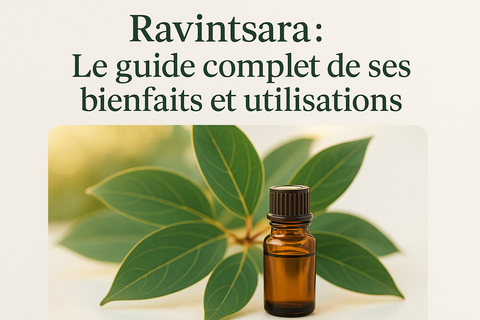
Ravintsara: Benefits and uses of this essential oil
Ravintsara, this "good leaf" native to Madagascar, has become an essential pillar of modern aromatherapy. Its name, derived from the Malagasy words ravina (leaf) and tsara (good), alone evokes the richness of its properties. Faced with the challenges of the cold seasons or periods of fatigue, ravintsara essential oil proves to be a precious ally for supporting the body. It offers a synergy of actions, acting on both the immune system and the respiratory sphere, while providing support for general well-being.
In this article, we will explore in depth the benefits of this natural wonder, its various uses, essential precautions to take, as well as expert advice for effectively integrating it into your daily routine. Our goal is to provide you with a complete and reliable guide, allowing you to get the most out of ravintsara, this multi-talented essential oil.
What is ravintsara?
Ravintsara, whose scientific name is Cinnamomum camphora, is a remarkable plant that is sparking growing interest in the world of natural health. Its history and biochemical composition are the keys to its exceptional properties, making it a major player in aromatherapy.
Origin and botany of ravintsara

Ravintsara is actually a camphor tree native to Asia (China, Japan, Taiwan) which, once introduced to Madagascar in the 19th century, evolved to develop a unique biochemical composition, very different from that of its Asian cousins. It is from this Malagasy adaptation that we derive the ravintsara essential oil as we know it today. The tree can reach an impressive height of 15 to 25 meters; its evergreen, oval, green leaves are the source of the oil through steam distillation.
Traditionally, the Malagasy use this "good leaf" as an infusion for its healing virtues, notably to counter infections and strengthen immune defenses. This transmission of ancestral knowledge highlights the cultural and medicinal importance of ravintsara in the region, long before its advent in Western aromatherapy. It is essential not to confuse it with other camphor tree chemotypes or with ravensara, a different tree, as we will see later.
Composition and active ingredients
The power of ravintsara lies mainly in its composition of 1,8-cineole, also called eucalyptol, which often accounts for more than 50% of the essential oil. This molecule is the source of its remarkable antiviral, expectorant, and anti-infective properties. Other beneficial compounds, such as sabinene, alpha-terpineol, limonene, and linalool, complete this biochemical profile, giving ravintsara a broad spectrum of action.
1,8-cineole is a powerful mucolytic and expectorant, helping to thin mucus and clear the respiratory tract. Alpha-terpineol, for its part, is known for its immunostimulant effects, strengthening the body's ability to fight against aggression. This synergy of active ingredients makes ravintsara essential oil a natural remedy of choice for preventing and supporting many winter ailments, while being well-tolerated by the skin and mucous membranes.
The health benefits of ravintsara

Ravintsara essential oil is a true panacea, recognized for its multiple health benefits. Its exceptional properties make it a precious ally for strengthening natural defenses and relieving various ailments, particularly those related to winter infections.
Antiviral and immune properties
Ravintsara is primarily celebrated for its powerful antiviral and immunostimulant properties. 1,8-cineole, its main component, acts as a shield by inhibiting the replication of many viruses and stimulating the activity of immune cells. This is why this essential oil is so effective in preventing and treating common viral infections such as flu, colds, herpes, shingles, or even viral gastroenteritis. A study published in the Journal of Essential Oil Research (Satyal P. et al., 2013) has indeed confirmed the significant antiviral activity of 1,8-cineole-rich Cinnamomum camphora oil.
During periods of low energy or stress, ravintsara helps to "boost" the immune system, making it more resilient in the face of external aggression. It's like giving your inner army a helping hand, equipping it better for battle. Regular application, especially on the soles of the feet, is an excellent way to strengthen natural defenses, particularly as a prevention against winter ailments.
Benefits for the respiratory system

Ravintsara essential oil is a champion of the respiratory sphere. Its mucolytic and expectorant properties, attributed to 1,8-cineole, help to thin mucus and facilitate its expulsion, thereby clearing congested respiratory tracts. Whether for a stuffy nose, a chesty cough, bronchitis, sinusitis, or nasopharyngitis, ravintsara provides notable relief. It acts a bit like a natural "lubricant" for your lungs and sinuses.
In case of a cold or flu, inhalation of ravintsara is particularly effective for freeing up the respiratory tract and soothing irritation. Its anti-inflammatory action also contributes to reducing mucous membrane inflammation, thus improving respiratory comfort. Many aromatherapy recipes incorporate ravintsara for these applications, often in synergy with other oils like Eucalyptus radiata or Niaouli.
Effects on the nervous system and well-being
Beyond its physical virtues, ravintsara is also an excellent balancer for the nervous system. It is recognized for its tonic and neurotonic properties, helping to combat nervous and physical fatigue, as well as low morale. A study conducted by Lima PR et al., 2013, explored the anxiolytic effects of compounds present in essential oils rich in 1,8-cineole, suggesting a calming potential.
Although energizing, this essential oil is not a stimulant; it allows one to regain calm and serenity in case of stress, anxiety, or sleep disorders. Through atmospheric diffusion, its fresh and aromatic scent creates an atmosphere conducive to relaxation and concentration, helping to dissipate mental fog and balance emotions. It is an excellent option for those seeking to improve their psycho-emotional well-being, offering welcome mental clarity.
How to use ravintsara essential oil?

Ravintsara essential oil is renowned for its versatility and good tolerance, making it accessible for various uses. However, it is crucial to always respect the instructions for use and the precautions to fully benefit from its virtues in complete safety.
Use in diffusion
Diffusion is one of the gentlest and most effective methods to enjoy the benefits of ravintsara. It allows for sanitizing the ambient air, preventing the spread of viruses, and promoting respiratory comfort. For optimal diffusion, use an essential oil diffuser. Add 5 to 15 drops of your ravintsara essential oil and diffuse for 10 to 20 minutes, ideally 2 to 3 times a day. Take care not to diffuse continuously, and above all, avoid the presence of young children under 1 year old or pregnant women during diffusion.

Marie's expert advice: For purified air and clear respiratory tracts during winter ailments, diffuse 10 drops of ravintsara in the morning to energize the space, and 10 drops in the evening, an hour before bedtime, to prepare for restful sleep. This routine is particularly beneficial during flu or cold epidemics. Do not hesitate to combine it with Scots pine or lemon essential oil for a purifying synergy.
Cutaneous application and massage

Cutaneous application is a preferred method for targeting specific areas of the body and benefiting from the properties of ravintsara. In a massage, the essential oil must always be diluted in a vegetable oil (sweet almond, jojoba, macadamia...). For adults and children over 7 years old, dilute 2 to 4 drops of ravintsara in a teaspoon of vegetable oil. Apply this mixture to the thorax, upper back, inside of the wrists, or the soles of the feet, 3 to 4 times a day, particularly in case of colds, coughs, bronchitis, or to strengthen the immune system.
Marie's expert advice: In case of a stuffy nose or the onset of a cold, prepare a pectoral balm by mixing 5 drops of ravintsara essential oil with 10 ml of Calophyllum or sweet almond vegetable oil. Gently massage the chest and upper back. For fatigue and stress, an application on the solar plexus and along the spine can provide relief. For children aged 3 to 6, a maximum dilution of 5% is recommended, and always upon medical advice. Always perform a prior skin test in the crook of the elbow to rule out any risk of allergy.
Ravintsara infusion

Although ravintsara essential oil is primarily used via diffusion or cutaneous application, ravintsara leaves can be consumed as an infusion to enjoy their benefits. This traditional Malagasy method is gentler and suitable for daily use, including for children over 6 years old, under supervision. To prepare an infusion, let 1 to 2 grams of dried leaves (or a few fresh leaves) simmer in 200 ml of water for 5 to 10 minutes. Strain and drink warm, possibly with a little honey to soften the taste.

Marie's expert advice: The infusion of ravintsara leaves is ideal for supporting the immune system and soothing the respiratory tract gently, without the drawbacks of direct oral use of essential oils. It is an excellent alternative for young children from 6 years old, in case of minor winter ailments. You can garnish it with a slice of lemon or a cinnamon stick to vary the pleasures and reinforce its properties. Nevertheless, for more targeted and powerful effects on acute infections, the essential oil remains the most effective method for adults.
Inhalation and other methods
Inhalation is a fast and effective method for relieving respiratory ailments, particularly a stuffy nose, sinusitis, or coughs. There are two types of inhalation:
- Dry inhalation: Place 2 to 3 drops of ravintsara essential oil on a clean tissue and breathe deeply for a few minutes. Repeat several times a day as needed.
- Wet inhalation: In a bowl of hot (not boiling) water, add 3 to 5 drops of ravintsara. Place your face over the bowl, head covered with a towel, and breathe in the vapors for 5 to 10 minutes, eyes closed to avoid any irritation.
Oral use: Ravintsara essential oil can be taken orally, but always with the utmost caution and on a neutral support (honey, sugar, neutral tablet, or food-grade vegetable oil). The usual dosage for adults is 1 to 2 drops, 2 to 3 times a day, for a short period (maximum 7 days). This route is particularly indicated for generalized viral infections or for intensive immune support. However, due to possible drug interactions and its 1,8-cineole content, it is imperative to consult a healthcare professional before any oral use, especially if you are undergoing medical treatment.
Marie's expert advice: For rapid action on a stuffy nose and sinusitis, opt for wet inhalation. It is a method that opens the respiratory tract very effectively. For generalized winter ailments, like flu or deep fatigue, oral use can be considered for adults, always under informed advice. For example, one drop on half a sugar cube or in a spoonful of honey, twice a day, can make a difference. But remember, this is a powerful essential oil; scrupulously respect the doses and duration of use.
Precautions for use and contraindications

Ravintsara is a generally well-tolerated essential oil, but like any active product, its use requires precautions. It is essential to be aware of them to avoid any adverse effects and ensure safe and effective aromatherapy.
Contraindications:
- Do not use in pregnant or breastfeeding women (particularly during the first three months of pregnancy).
- Not recommended for children under 3 years old. For children aged 3 to 6, medical advice is mandatory and the essential oil must be heavily diluted (maximum 5%) for cutaneous application or short-duration diffusion.
- Not recommended for asthmatic subjects, especially via inhalation or direct diffusion, without prior medical advice from an allergist. Eucalyptol can potentially cause bronchial spasms in sensitive individuals.
- Use with caution in people with epilepsy or a history of febrile seizures, due to the presence of natural camphor, although low in Madagascar ravintsara.
- Possible interactions with medications, notably via oral use, due to its 1,8-cineole content, which can have an inducing effect on certain liver enzymes. Consult your doctor or pharmacist before any use concomitant with medical treatment.
General precautions for use:
- Always dilute the essential oil for any cutaneous application with a vegetable oil.
- Perform a cutaneous application test in the crook of the elbow at least 48 hours before more extensive use, to verify the absence of any allergic reaction (redness, irritation).
- Avoid contact with eyes, the eye contour, and mucous membranes. In case of contact, rinse thoroughly with a neutral vegetable oil, then with water.
- Keep essential oils out of the reach of children.
- Do not exceed the recommended dosages. Prolonged use without interruption is not recommended.
Marie's expert tip: Ravintsara is an essential oil that is gentle on the skin, but "gentle" does not mean "harmless." Scrupulously respect the dilution guidelines and contraindications, especially with vulnerable groups such as young children. For them, always prioritize gentle, short-duration diffusion or highly diluted skin application on the soles of the feet. When in doubt, a consultation with a healthcare professional (doctor, pharmacist, aromatherapist) is the best precaution. This is the key to a calm and effective use of this wonder of nature.
Ravintsara: what are the possible synergies?

Ravintsara is an essential oil whose properties can be magnified when combined with other essential oils or natural substances. These synergies make it possible to optimize the benefits and broaden the spectrum of action, particularly for the respiratory system and the immune system.
-
For respiratory comfort (colds, coughs, stuffy nose):
Combine ravintsara with Radiata Eucalyptus or Niaouli essential oil. These two oils, also rich in 1,8-cineole, reinforce the mucolytic and expectorant action. A synergy of 3 drops of ravintsara, 2 drops of Radiata Eucalyptus, and 1 drop of Niaouli, diluted in 5 ml of vegetable oil and massaged onto the chest and back, can work wonders against bronchitis or sinusitis. -
To boost immunity (prevention of winter ailments):
Ravintsara pairs perfectly with Tea Tree essential oil. Their complementary antiviral and antibacterial properties offer a reinforced shield. A blend of 2 drops of ravintsara and 1 drop of Tea Tree on the soles of the feet each morning, diluted in a vegetable oil, effectively stimulates the immune system and prevents the flu. -
For fatigue and stress:
For its benefits on the nervous system, ravintsara can be associated with True Lavender or Petitgrain Bigarade essential oil. These synergies create a relaxing atmosphere and promote better sleep. In diffusion, a few drops of each essential oil before bedtime help to soothe the mind and reduce stress. -
For air purification:
Combine ravintsara with Lemon or Scots Pine essential oil for diffusion. These combinations purify the atmosphere and spread a fresh, pleasant scent, preventing the spread of infections.
Marie's expert tip: Synergies are the strength of aromatherapy. For a well-established flu, a simple and effective recipe for adults is to mix equal parts ravintsara, Radiata Eucalyptus, and Noble Laurel. Apply 6 drops of this mixture to the chest and upper back, 6 times a day for 2 to 3 days. For children over 6 years old, always dilute in a vegetable oil and reduce the doses. Always remember to adapt the proportions and methods of use based on the person's age and sensitivity. A good synergy is like a well-coordinated team: everyone brings their specialty for a multiplied overall result.
Ravintsara and ravensara: what are the differences?
It is very common to confuse ravintsara and ravensara, particularly due to the similarity of their names and their Malagasy origin. However, these are two distinct essential oils, derived from different plants and possessing their own biochemical and therapeutic properties. Understanding this distinction is crucial for safe and effective use in aromatherapy.
| Characteristic | Ravintsara (Cinnamomum camphora ct cineole) | Ravensara (Ravensara aromatica) |
|---|---|---|
| Botanical name | Cinnamomum camphora ct cineole | Ravensara aromatica |
| Origin | Camphor tree imported and adapted to Madagascar | Tree endemic to Madagascar |
| Main components | Mostly 1,8-cineole (> 50%), sabinene, alpha-terpineol | Mainly sabinene, limonene, methyl chavicol (estragole), alpha-terpineol (very little 1,8-cineole, < 4%) |
| Scent | Fresh, slightly camphoraceous, reminiscent of eucalyptus | Softer, aniseed, spicy, herbaceous, earthy citrus |
| Main properties | Powerful antiviral, immunostimulant, expectorant, mucolytic, general tonic | Antiviral, anti-infectious, relaxing, antispasmodic, analgesic, anti-inflammatory |
| Main indications | Viral infections (flu, cold, bronchitis, herpes, shingles), fatigue, immune system support, stress, sleep | Viral infections, stress, anxiety, muscle fatigue, cramps, immune and lymphatic system support |
| Routes of administration | Diffusion, skin application (diluted), inhalation, oral route (with precautions) | Diffusion, skin application (diluted). Oral route not recommended. Can be irritating to the skin. |
As you can see, the major difference lies in the chemotype, i.e., the chemical composition. Ravintsara is dominated by 1,8-cineole, which gives it its powerful antiviral and expectorant properties. Ravensara, on the other hand, contains very little of this molecule but is rich in sabinene and methyl chavicol, giving it different properties that are more focused on relaxation and anti-inflammatory effects, but potentially more irritating to the skin and not recommended for the oral route.
Marie's expert tip: When buying an essential oil, always check the full botanical name (Cinnamomum camphora ct cineole for ravintsara) to avoid any confusion. Do not rely solely on common names. This rigor is fundamental to ensuring the safety and effectiveness of your aromatherapy, especially in the face of infections and winter ailments where the specific properties of ravintsara are sought.
Frequently asked questions about ravintsara
Here are some frequently asked questions to deepen your knowledge of ravintsara and its uses.
Can ravintsara replace medical treatment?
No, ravintsara essential oil is a natural supplement that can accompany medical treatment, but it should under no circumstances replace it without the advice of a healthcare professional. In case of serious or persistent infections, a medical consultation is essential.
Can ravintsara be used on a baby?
The use of ravintsara essential oil is generally contraindicated for babies under 3 years old. For children aged 3 to 6, use is possible under medical advice, always highly diluted and on limited areas such as the soles of the feet. Very short diffusion at a low dose is a gentler alternative.
Is ravintsara effective against dry coughs?
Ravintsara is primarily mucolytic and expectorant, making it more effective against wet coughs. For dry coughs, other essential oils with soothing and antitussive properties (such as cypress or true lavender) might be more appropriate, often in synergies.
How long can ravintsara be used orally?
The oral route for ravintsara essential oil is generally recommended for a short period, not exceeding 5 to 7 days, and always under medical advice due to potential interactions with certain medications. Prolonged use is not recommended.
Can ravintsara be used in case of chronic fatigue?
Ravintsara has tonic and energizing properties that can help fight temporary fatigue. However, for chronic fatigue, it is important to find the cause with a healthcare professional. Ravintsara can be a support, but not a sole solution. It is not the plant to prioritize first.
Is it possible to be allergic to ravintsara?
Yes, as with any essential oil, a risk of allergy exists. Some of its natural components, such as limonene and linalool, can be sensitizing in some people. It is imperative to perform a preliminary skin test before extensive skin application.
Does ravintsara help with de-stressing?
Ravintsara is known for its balancing action on the nervous system. It can help soothe stress and mild anxiety, promoting a sense of calm and mental clarity. Diffusion or skin application on the solar plexus are common uses for this purpose.
Does ravintsara have an antifungal action?
Yes, 1,8-cineole, present in large quantities in ravintsara, gives this essential oil antifungal properties, in addition to its antiviral and antibacterial actions. It can be used, diluted, for certain cutaneous fungal infections, but always with discernment.
Conclusion
Ravintsara is undoubtedly an essential oil with remarkable and varied properties, a true pillar of aromatherapy for supporting health and well-being on a daily basis. From its powerful antiviral and immunostimulant actions to its benefits for the respiratory system and its soothing role on the nervous system, it stands out as an essential ally for dealing with winter ailments, fatigue, and stress.
Its multiple uses – in diffusion to sanitize the air, in skin application for a targeted massage, in inhalation to clear a stuffy nose, or even in an infusion of its leaves for gentle support – make it a versatile and precious product. However, as we have emphasized, the use of ravintsara requires rigor and caution, particularly regarding dosage, contraindications, and specific precautions for each public, especially children.
As a specialized advisor with my 15 years of experience at Pleine Forme, I encourage you to integrate ravintsara into your wellness routine, always respecting the recommendations for use and favoring quality products. Nature offers us treasures; let us learn to use them with wisdom and knowledge.
Have you already used ravintsara? What benefits have you observed? Do not hesitate to share your experiences and tips in the comments below. Your testimony will enrich this community and help other readers discover the virtues of this precious essential oil and the plant in general. Together, let us continue to explore the paths of a natural and enlightened health.


Comments (1)
Gracias por la valiosa información aportada.